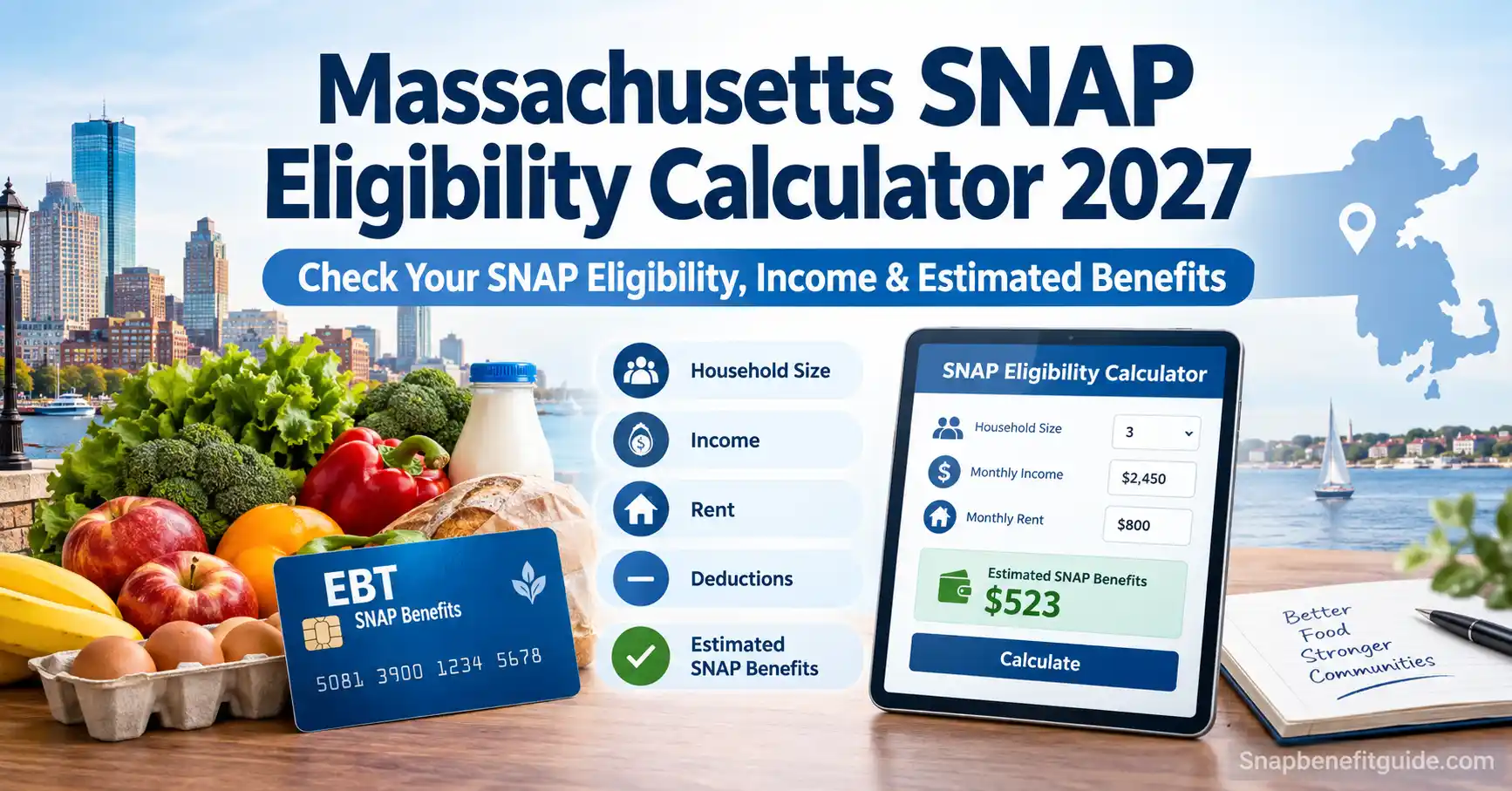
Wondering if your household qualifies for food assistance in Massachusetts? The Massachusetts SNAP Eligibility Calculator 2027 gives you a real estimate — not a guess — based on how the Department of Transitional Assistance actually calculates benefits.
SNAP, once known as food stamps, is run in Massachusetts by the Department of Transitional Assistance (DTA). What you qualify for comes down to three things: who’s in your household, what you earn, and which deductions apply to you. DTA also runs its own official screener and publishes the standards it uses.
One thing to keep in mind before you go further: a calculator estimates. It doesn’t decide. Only DTA can make that call, and only after reviewing your actual application.
Massachusetts SNAP Calculator 2027: Quick Answer
Household size, gross income, deductions, housing costs, utilities, dependent care, medical expenses where they apply — a solid Massachusetts SNAP calculator weighs all of it. DTA then runs its own calculation rules on top of that to land on your actual benefit.
How the Massachusetts SNAP Eligibility Calculator Works
Here’s where most online calculators go wrong: they apply a generic national SNAP formula instead of following the sequence Massachusetts DTA actually uses.
Step 1: Determine your SNAP household
Your SNAP household is generally the people who buy and cook food with you.
But there’s a catch. Some people have to be counted whether or not they share meals with you — a spouse living in your home, for instance, or children under 22. Those inclusions aren’t optional.
Step 2: Enter monthly income
DTA counts income from a wide range of sources:
- Wages and salary
- Self-employment income
- Social Security
- SSI or SSDI
- Unemployment compensation
- Child support
- Certain other cash income
Weekly income gets converted to monthly using 4.333 weeks per month. So $500 a week works out to $2,166.50 a month — not a flat multiplication by four.
Step 3: Apply SNAP deductions
Your countable income can shrink once qualifying deductions are applied. Depending on your household, that might include:
- 20% earned-income deduction
- Standard deduction
- Dependent-care expenses
- Certain medical expenses
- Legally obligated child support
- Eligible shelter expenses
- Certain utility expenses
DTA is clear that which deductions apply depends entirely on your circumstances. No two households look the same here.
Step 4: Calculate net income
The math, simplified:
Gross income − applicable SNAP deductions = net income
This is where a lot of people trip up. Your benefit isn’t based on your paycheck before deductions — it’s based on what’s left after them.
Step 5: Estimate the SNAP benefit
DTA’s formula: take the household’s maximum SNAP amount and subtract 30% of monthly net income. That’s the benefit.
A calculator worth using shows you this math — not just a number that appears out of nowhere.
Massachusetts SNAP Income Limits for 2027
A lot of confusion around Massachusetts SNAP eligibility comes down to one thing: generic calculators don’t reflect how Massachusetts actually screens applicants. If you want limits broken out by state, SNAP income limits by state is a good place to compare how Massachusetts stacks up against its neighbors.
Why you should not blindly use a 130% FPL calculator
Plenty of national SNAP sites lean on the traditional federal 130% FPL gross-income test as their core calculation.
That’s not what Massachusetts uses.
Massachusetts runs on Broad-Based Categorical Eligibility (BBCE), with a published categorical gross-income standard of 200% of the Federal Poverty Level for most SNAP households. Two calculators, two very different answers — and now you know why.
For a 2027 calculator, check the effective date on the DTA chart before trusting a dollar figure. Dates matter more than people assume.
Current DTA figures are not automatically 2027 figures
Right now, DTA’s published numbers reflect a current household-size table. The 2027 standards need to be verified against the updated DTA chart once it takes effect — DTA maintains those separately, and they don’t carry over automatically.
Why does this matter so much? Because SNAP maximums and income standards shift with annual federal cost-of-living adjustments. What’s true today may not be true in a few months.
How Much SNAP Can You Get in Massachusetts?
Household size drives your maximum possible benefit. But here’s the reality: most eligible households get less than the max, because income and deductions pull that number down.
DTA’s current maximum monthly SNAP figures:
| Household size | Current maximum monthly SNAP |
|---|---|
| 1 | $298 |
| 2 | $546 |
| 3 | $785 |
| 4 | $994 |
| 5 | $1,183 |
| 6 | $1,421 |
| 7 | $1,571 |
| 8 | $1,789 |
| Each additional person | +$218 |
These are current figures — not confirmed 2027 amounts. Check the DTA table that’s effective for 2027 before you publish or rely on any calculator result built around them.
Income and allowable deductions can pull your actual benefit well below the maximum. That’s normal, not a red flag.
Does Rent Affect SNAP Benefits in Massachusetts?
Yes — and it’s one of the more overlooked pieces of the calculation.
DTA’s methodology folds in shelter expenses, and eligible households can receive deductions tied to housing and utilities. Medical expenses matter too, but only when a household member is 60 or older or has a qualifying disability.
When you sit down with a Massachusetts SNAP calculator, have these ready:
- Rent or mortgage
- Heating costs
- Electricity
- Certain other utilities
- Childcare
- Qualifying medical expenses
- Legally required child support
Skip one of these and your estimate gets less accurate. It’s that simple.
Can You Get SNAP If You Work?
Yes. Having a job doesn’t knock you out of the running.
DTA looks at income and household circumstances together. A working household can still qualify — especially when income is modest and deductions bring countable income down further.
Massachusetts also layers on its own work-related rules. Some adults need to meet general work requirements or ABAWD rules unless they qualify for an exemption.
So the question isn’t really “do I have a job?” It’s this: what’s my countable household income, and which work requirements — if any — apply to me?
SNAP Rules for Seniors and Disabled Households
Elderly or disabled household members change the calculation. Certain medical expenses become deductible, and special rules kick in that don’t apply to a standard household.
If you’re 60 or older, living with a disability, or caring for someone who is, make sure your calculator actually accounts for that — don’t let it treat your household like every other one.
What About Social Security, SSI, or Unemployment?
These aren’t invisible income. DTA counts Social Security, unemployment insurance, and child support right alongside wages.
So receiving Social Security doesn’t automatically shut the door on SNAP.
And being unemployed doesn’t automatically open it, either. Household size, income, expenses, and the rules that apply to your situation still carry the weight.
What Is Changing for Massachusetts SNAP in 2027?
Pay attention to this one. Massachusetts Legal Help reports that the ABAWD 36-month clock restarts on January 1, 2027. Right now, DTA describes the existing three-month time-limit period as running through December 31, 2026.
ABAWD rules touch certain adults subject to work requirements who don’t qualify for an exemption.
DTA currently lists several exemption categories — age, pregnancy, disability, caregiving, education, and a handful of other situations.
Federal and state SNAP policy shifts constantly. A 2027 calculator worth your time should state clearly which rules and effective dates it’s built on.
Massachusetts SNAP Calculator vs. Official DTA Decision
| Calculator estimate | Official DTA determination |
|---|---|
| Provides an estimate | Provides the eligibility decision |
| Uses information you enter | Uses your application and verification |
| Useful for planning | Legally/programmatically authoritative |
| May use assumptions | Applies current DTA rules |
| Not an approval | Determines whether benefits are issued |
A calculator telling you that you might qualify is a green light to apply — not a guarantee. DTA specifically tells people who are unsure to just apply and let staff sort it out.
How to Apply for Massachusetts SNAP
Once you’ve got an estimate, the next move is applying through DTA directly.
Before you start, gather:
- Household members
- Income sources
- Recent pay information
- Rent or mortgage
- Utility expenses
- Childcare costs
- Medical expenses when applicable
- Child-support payments
- Other information DTA requests
DTA Connect handles online applications, and there are other ways to apply or get help if you’d rather not go it alone. Once you’re approved, it’s worth knowing when SNAP payments actually get deposited so you can plan around it.
Find Massachusetts SNAP Help Near You
SNAP runs statewide, so none of this changes whether you’re in:
- Boston
- Worcester
- Springfield
- Lowell
- Cambridge
- Brockton
- New Bedford
- Quincy
- Lynn
- Fall River
- Lawrence
- Framingham
- Somerville
- Haverhill
- Waltham
- Pittsfield
Looking for local help? Search for DTA resources, SNAP outreach groups, community assistance programs, or a DTA office near you.
Worth remembering: “SNAP office near me” is an assistance search. The eligibility calculator is a statewide tool. Different jobs entirely. If you’re weighing Massachusetts against another state, the SNAP eligibility calculator by state breaks that down too.
Common Massachusetts SNAP Calculator Mistakes
- Using an outdated 2026 or earlier income chart for 2027.
- Automatically applying the federal 130% FPL rule to Massachusetts.
- Confusing gross income with net income.
- Leaving rent or qualifying utilities out of the calculation.
- Assuming employment automatically makes you ineligible.
- Ignoring Social Security or unemployment income.
- Putting everyone at an address into one SNAP household.
- Treating the maximum benefit as the amount everyone receives.
- Ignoring elderly/disabled household rules.
- Treating an unofficial calculator result as an approval.
FAQs About SNAP Calculator MA
1. What is the Massachusetts SNAP income limit in 2027?
Use the DTA chart effective for 2027 — that’s the only reliable source. Massachusetts runs on a 200% FPL categorical-eligibility standard for most households, not the generic 130% FPL test.
2. How much can I make and still get SNAP in Massachusetts?
It depends on household size, income type, deductions, and which standard applies to you. A higher income alone doesn’t disqualify you.
3. How much SNAP will I get in Massachusetts?
Household size and net income drive it. DTA subtracts 30% of your monthly net income from the household’s maximum SNAP amount.
4. Does rent increase SNAP benefits in Massachusetts?
Eligible shelter expenses can shift your calculation. Rent and certain utilities matter — how much depends on your household.
5. Can I get SNAP if I work?
Yes. Employment alone doesn’t disqualify you. Income, household size, deductions, and work requirements all factor in.
6. Can I get SNAP while receiving Social Security?
Possibly. DTA counts Social Security as income, but receiving it doesn’t automatically mean ineligibility.
7. Does Massachusetts have a SNAP asset limit?
DTA publishes specific asset standards that vary by situation. Skip the generic calculators — check DTA’s current charts directly.
8. Who counts as a SNAP household?
Usually, people who buy and cook food together. Spouses and children under 22 living together are counted regardless.
9. What is the difference between gross and net SNAP income?
Gross is before deductions. Net is what’s left after qualifying deductions are applied — and net is what DTA uses for your benefit.
10. Should I apply if an online calculator says I qualify?
Yes. A calculator estimates. Only an application gets you an actual answer from DTA.
Conclusion
A good Massachusetts SNAP calculator only works if it reflects how DTA actually does the math — not a national average dressed up as state-specific advice. Enter your household size, income, rent, utilities, and other qualifying expenses honestly, and pay close attention to the 200% FPL standard and the 2027 ABAWD transition.
Use the number it gives you as a starting point, not a verdict. The real answer comes from DTA — so if the estimate looks promising, don’t sit on it. Apply.
Official Resources
- Check SNAP Eligibility — Mass.gov
- Apply for SNAP Online — DTA Connect
- Verify Income Standards — Mass.gov DTA Eligibility Charts
- Find SNAP Outreach Help — Mass.gov
This calculator information is for educational and estimation purposes only. SNAP rules, income limits and benefit amounts can change. Always verify current 2027 requirements with Massachusetts DTA before making an application or eligibility decision.

Sohail Asghar is a U.S. benefits researcher with over 2 years of dedicated experience studying EBT, SNAP, and Medicaid programs. He has helped thousands of readers understand their eligibility, payment schedules, and benefit rights through in-depth research and analysis of official government sources. His work focuses on making complex government benefit information simple and accessible for everyday Americans.