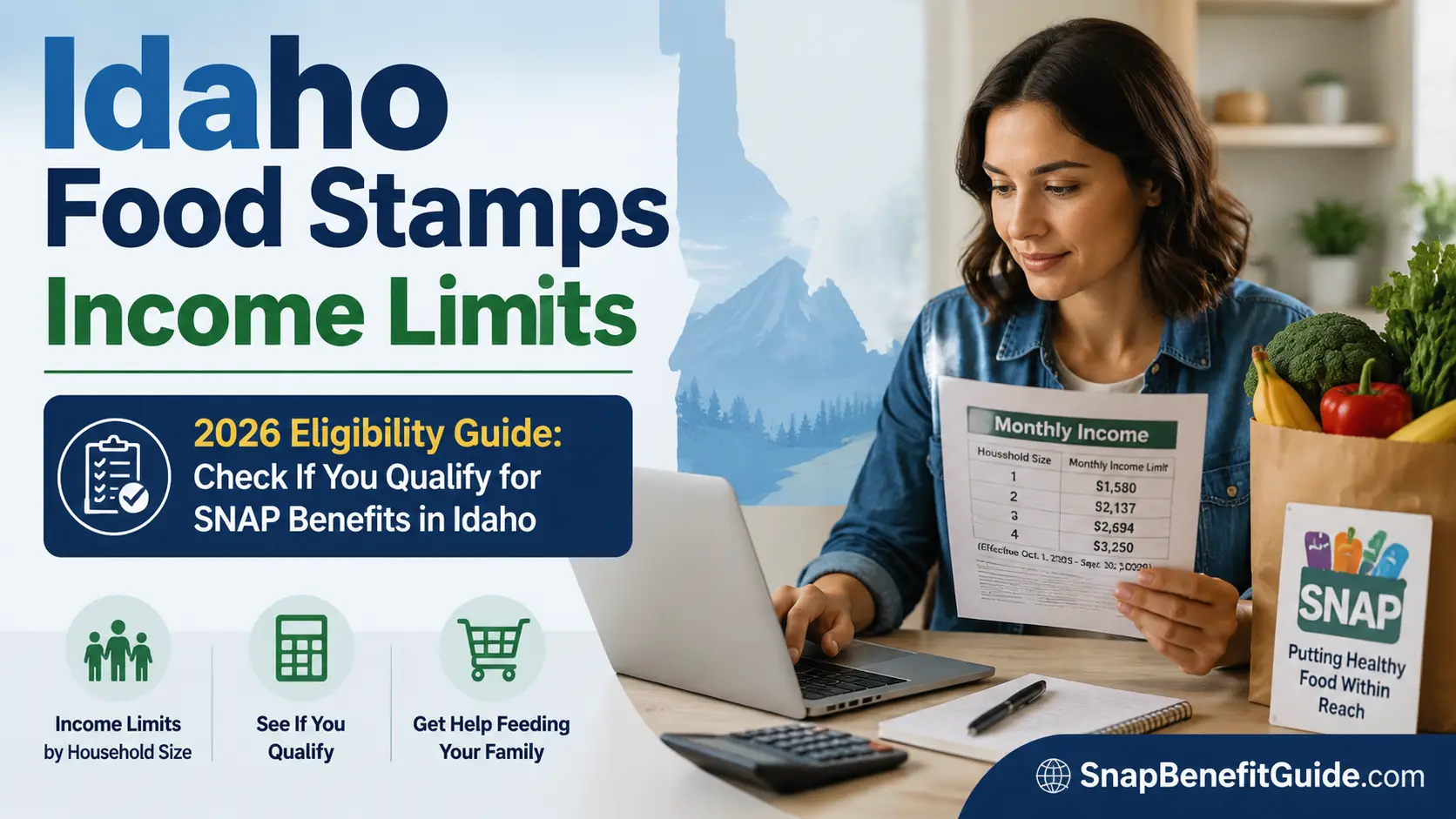
Most people searching “Idaho food stamps income limits” want one thing — a clear answer on whether they qualify. The program officially manage by the Supplemental Nutrition Assistance Program, or SNAP. Food stamps is the old name that, and everyone still uses it.
SNAP gives monthly benefits through an Electronic Benefit Transfer (EBT) card accepted at participating grocery stores and retailers across Idaho.
Income is the biggest factor in eligibility, but it’s not the only one. The Idaho Department of Health and Welfare (IDHW) also looks at household size, your actual expenses, and deductions you may not even know you’re entitled to. If something changed recently — a layoff, fewer hours, a rent hike, a new childcare bill — don’t assume you’re out. Run the numbers first.
What Are Idaho Food Stamps (SNAP)?
SNAP is a federal nutrition assistance program controlled nationally by the USDA Food and Nutrition Service. In Idaho, the Idaho Department of Health and Welfare managed administration.
Benefits load monthly onto an Idaho EBT card — sometimes called a Quest card — and it works like any debit card at approved retailers.
Approved purchases:
- Fruits and vegetables
- Meat and seafood
- Dairy products
- Bread and cereals
- Seeds and plants that grow food
Not covered:
- Alcohol
- Tobacco products
- Vitamins and supplements
- Household supplies
- Non-food items
Idaho SNAP Income Limits Explained
What Is the Income Limit for Food Stamps in Idaho?
Idaho SNAP income limits are tied to family size, monthly income, allowable deductions, and federal poverty rules. Both gross and net income play a vital role — and the thresholds update periodically.
Get the current figures directly from the Idaho Department of Health and Welfare before you apply. Using outdated numbers can lead you to the wrong conclusion.
Idaho Food Stamp Income Chart by Household Size
Household size drives a significant portion of what you qualify for.
| Household Size | Monthly Income Consideration |
|---|---|
| 1 person | Lower income households may qualify based on SNAP limits and deductions |
| 2 people | Limits increase because household needs are higher |
| 3 people | Eligibility depends on combined household income and expenses |
| 4 people | Larger families may qualify with higher income limits |
| 5+ people | Additional household members increase allowable income limits |
That said, size is just the starting point. Your final eligibility also moves based on:
- Rent or mortgage costs
- Utility expenses
- Childcare expenses
- Medical expenses
- Earned income deductions
- Household circumstances
Gross Income vs Net Income for Idaho SNAP
Most people look at their paycheck and assume that’s the number SNAP uses. It isn’t.
Gross Income
Gross income is everything coming in before any deductions — wages, salaries, self-employment earnings, unemployment benefits, Social Security, disability payments, child support, and pension income all count here.
Net Income
Net income is what remains after SNAP-approved deductions come off the top. Housing costs, utility bills, childcare, qualifying medical expenses, and standard deductions all reduce your countable income.
Someone who looks over the limit based on gross income alone may come in under it once deductions are applied. That gap matters.
Who Qualifies for SNAP in Idaho?
Working Families
Employment doesn’t disqualify you. A lot of Idaho households receive SNAP while working full-time because their income — measured against their actual expenses — still falls within program guidelines.
Seniors
Older adults on fixed incomes qualify more often than people expect. Medical expense deductions and housing costs can substantially lower countable income for this group.
Individuals With Disabilities
Disability benefits count as income, but receiving them doesn’t close the door. Eligibility comes down to the full financial picture.
Unemployed Individuals
Unemployment creates immediate financial stress, and SNAP is designed for exactly this kind of gap. Meet the income and household requirements, and there’s a strong case for eligibility.
Students
College students face a separate set of rules. Certain exemptions apply, so don’t assume you’re automatically excluded — look into the specific conditions.
Idaho SNAP Eligibility Requirements Checklist
Residency Requirements
You need to live in Idaho. Residents across the state search for assistance through:
- Idaho SNAP benefits
- Boise food stamps assistance
- Idaho Falls SNAP office
- Pocatello food assistance
- Coeur d’Alene SNAP help
Household Rules
SNAP defines a household as people who live together, buy food together, and prepare meals together — not just anyone sharing an address.
Married couple — one household.
Parent and child — counted together in most cases.
Roommates — can apply separately if they genuinely shop and cook independently.
Idaho SNAP Income Deductions That May Help You Qualify
When income sits close to the limit, deductions aren’t a technicality — they’re the whole ballgame.
Housing Costs
Rent, mortgage payments, and related property costs are deductible.
Utility Expenses
Heating, electricity, and cooling bills can qualify. Don’t leave these off your application.
Childcare Expenses
Work-related childcare costs reduce your countable income directly. Report every dollar.
Medical Expenses
Certain out-of-pocket medical costs apply as deductions for elderly or disabled household members — another reason this group qualifies more often than expected.
Can You Get Food Stamps in Idaho If You Work Full Time?
Yes. Full-time employment alone is not a disqualifier.
The Idaho Department of Health and Welfare evaluates total household income against household size, actual expenses, and available deductions. A two-income household can absolutely qualify if the combined financial picture meets SNAP guidelines. The only way to know for certain is to apply.
Does Unemployment Count as Income for SNAP Idaho?
Yes — unemployment benefits are counted as income in the SNAP eligibility calculation.
Report every source accurately: unemployment payments, wages, any benefits, child support, and other financial assistance. Leaving something out creates problems that delay or derail your application.
How Much SNAP Benefits Can You Receive in Idaho?
No fixed answer here — benefit amounts depend on household size, income, deductible expenses, and what deductions apply to your specific situation.
Two households with the same number of people can receive very different benefit amounts. The Idaho SNAP eligibility calculator provide you a rough estimate, but the official approval comes from the Idaho Department of Health and Welfare.
How to Apply for Food Stamps in Idaho
Step 1: Check Your Eligibility
Start by taking stock of who’s in your family, your combined current income, your monthly expenses, and your residency status.
Step 2: Gather Required Documents
You’ll need:
- Identification
- Proof of Idaho residency
- Income documents
- Rent or mortgage information
- Utility bills
- Social Security numbers
- Other verification documents
Step 3: Submit an Idaho SNAP Application
Applications go through Idaho Department of Health and Welfare services. Common searches that lead people here:
- Idaho SNAP application online
- Apply for food stamps Idaho
- Idaho EBT eligibility
Step 4: Complete the Interview
Most applicants go through an eligibility interview covering household composition, income, expenses, and housing. Be specific and thorough — vague answers slow things down.
Step 5: Receive Your Decision
Approval means benefits start loading onto your Idaho EBT card on a monthly basis.
Where Can Idaho Residents Get SNAP Assistance?
Resources are available through Idaho Department of Health and Welfare offices, local social service organizations, community assistance programs, and food banks.
Service areas include Boise, Meridian, Nampa, Idaho Falls, Pocatello, Coeur d’Alene, Twin Falls, Caldwell, and Lewiston — among others statewide.
SNAP vs Food Banks: What Is the Difference?
| SNAP | Food Banks |
|---|---|
| Government assistance program | Community support service |
| Monthly EBT benefits | Food donations or packages |
| Eligibility requirements apply | Different qualification rules |
| Used at approved retailers | Usually distributed directly |
These aren’t mutually exclusive. Many households use both, and there’s nothing wrong with that.
Helpful SNAP Guides
Before registrations, these three resources can save you time and prevent guesswork.
- Check 2026 SNAP Income Limits by State — See Every State’s Eligibility Threshold
- Use Our Free SNAP Eligibility Calculator — Get Your Estimated Benefit in Minutes
- Find Your Idaho EBT Payment Date — See Exactly When Benefits Hit Your Card
Common Idaho SNAP Application Mistakes
Not Reporting All Income
Wages, benefits, child support, unemployment — all of it needs to be reported. Omissions create complications, and they tend to surface at the worst time.
Ignoring Available Deductions
Rent, utilities, childcare, applicable medical expenses — if you don’t report them, they can’t reduce your countable income. That’s money left on the table.
Assuming You Earn Too Much
Honestly, this is the mistake that costs people the most. Gross income looks different from net income after deductions, and a lot of people who assume they’re over the limit actually aren’t. Apply first. Find out.
Missing the Interview
A missed interview or incomplete application stalls everything. Stay on top of any follow-up steps after you submit.
Idaho SNAP Eligibility Decision Guide
- If your income is below SNAP guidelines → Apply and bring documentation.
- If your income is slightly above the limit → Review your deductions before walking away.
- If your housing costs are high → Net income after deductions may bring you within range.
- If your financial situation recently changed → Submit updated information without delay.
Frequently Asked Questions (FAQs)
1. What is the income limit for food stamps in Idaho?
The SNAP income limits varies by family members, gross income, net income after allowable deductions, and current federal SNAP rules. Always verify the current numbers with IDHW directly.
2. How much can one person make and still get SNAP in Idaho?
A single person’s eligibility turns on monthly income, applicable deductions, and the current SNAP rules for that benefit year.
3. Can I get food stamps in Idaho if I work?
Yes. Many working Idaho residents qualify — employment alone doesn’t close the door.
4. Does rent affect Idaho SNAP eligibility?
Yes. Housing costs reduce your countable net income through SNAP deductions, which can move the eligibility needle significantly.
5. Does Idaho SNAP check bank accounts?
Financial information may be reviewed depending on household circumstances and applicable program rules.
6. How long does SNAP approval take in Idaho?
Timeline depends on application completeness and how quickly required verification gets resolved.
7. What documents are needed for Idaho SNAP?
Identification, proof of income, Idaho residency documentation, and records of your household expenses.
8. Can seniors qualify for Idaho SNAP?
Yes — and more often than people realize. Medical expense deductions make a real difference for many older applicants.
9. How do I apply for Idaho food stamps online?
Submit through Idaho Department of Health and Welfare services and complete the required verification steps.
Conclusion
The biggest mistake people make is deciding they don’t qualify before they actually check. Deductions exist for a reason — they’re built into the program to account for real expenses that reduce what you actually have available for food.
If your situation changed, your income dropped, or your bills went up, the math may work differently than you think. The Idaho Department of Health and Welfare makes the call. Let them.
Official Resources
- Apply for Idaho SNAP Benefits — Idaho Department of Health and Welfare
- Check 2026 SNAP Income Eligibility Standards — USDA Food and Nutrition Administration
- Start Your Idaho SNAP Application Online — idalink Self-Service Portal
- Verify 2026 SNAP Allotments and Income Limits — USDA FNA COLA Table
Disclaimer: These Food Stamps income limits, eligibility criteria, and benefit amounts can change based on federal and state rules. This guide gives general educational info and should not be considered official eligibility approval or financial advice. Always confirm current requirements policy with the Idaho Department of Health and Welfare before registration.

Sohail Asghar is a U.S. benefits researcher with over 2 years of dedicated experience studying EBT, SNAP, and Medicaid programs. He has helped thousands of readers understand their eligibility, payment schedules, and benefit rights through in-depth research and analysis of official government sources. His work focuses on making complex government benefit information simple and accessible for everyday Americans.