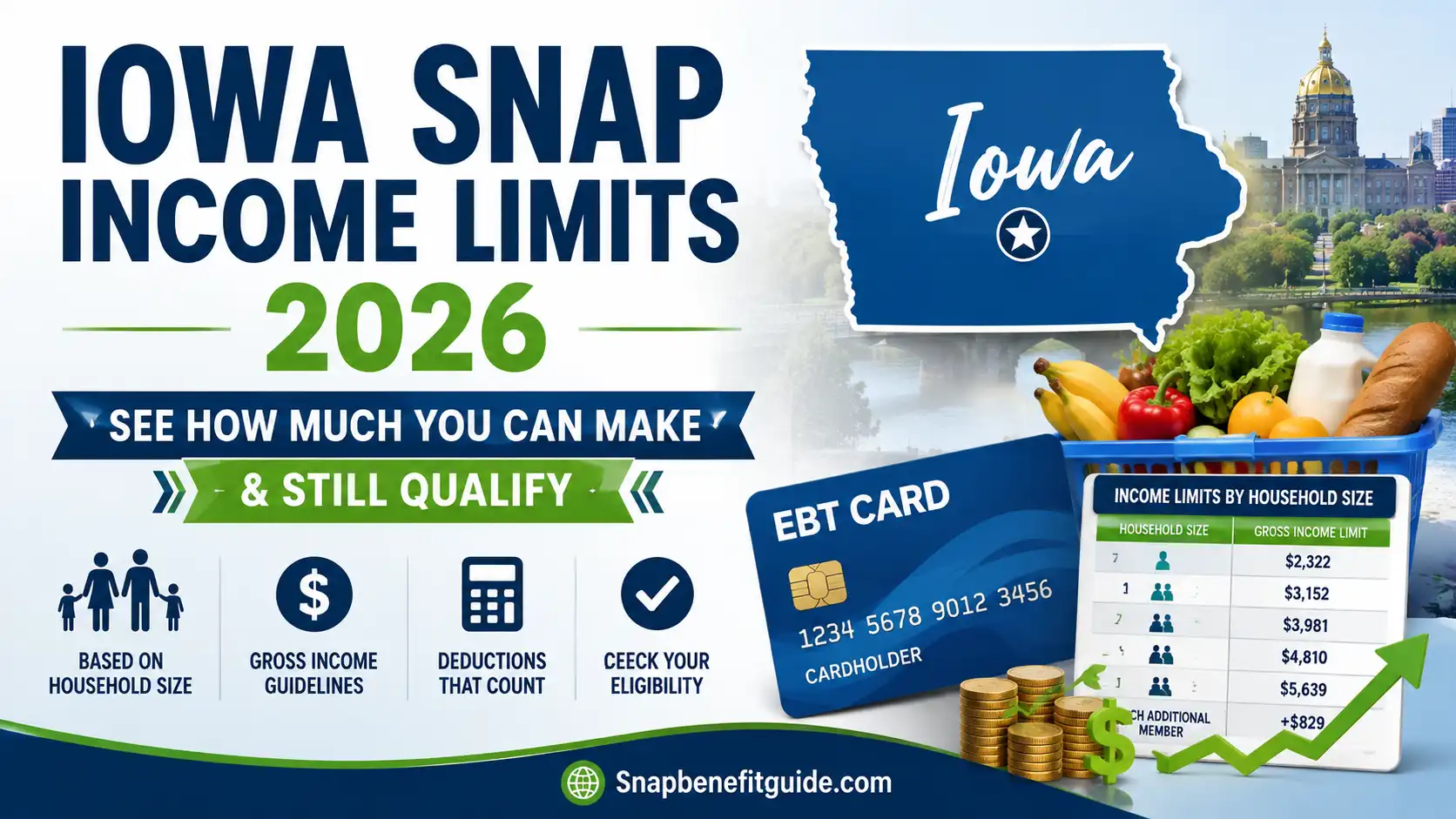
Most people searching for Iowa SNAP income limits find a national chart that shows 130% of the Federal Poverty Guidelines — and then assume they make too much to qualify. That chart is wrong for Iowa. The state uses Broad-Based Categorical Eligibility (BBCE), which raises the gross-income screening threshold to 160% of the Federal Poverty guidelines.
For the current federal fiscal year — October 1, 2025 through September 30, 2026 — the gross monthly income limit is about $2,087 for individual, $2,820 for 2 persons, and $4,287 for a 4-members household. Iowa’s 160% standard is confirmed in state policy materials.
Gross income is only the first filter. Household size, net income after deductions, age, disability status, and household composition all factor into the final decision.
Iowa SNAP Income Limits at a Glance
For most Iowa households, the key screening number is 160% of the Federal Poverty Guidelines under the state’s categorical eligibility rules. (Health & Human Services)
Approximate monthly limits for FY 2026:
| Household Size | Gross Monthly Limit — 160% FPG | Net Monthly Limit |
|---|---|---|
| 1 | $2,087 | $1,305 |
| 2 | $2,820 | $1,763 |
| 3 | $3,554 | $2,221 |
| 4 | $4,287 | $2,680 |
| 5 | $5,020 | $3,138 |
| 6 | $5,754 | $3,596 |
| 7 | $6,487 | $4,055 |
| 8 | $7,220 | $4,513 |
| Each additional person | About +$733 | +$459 |
The 160% figures are based on current federal poverty guidelines thresholds; Iowa legislative materials list annual 160% FPL amounts of $25,040 for single person and $51,440 for 4 members family. (Iowa Legislature)
These numbers are a starting point, not a verdict. Iowa HHS makes the final call based on the authentic family details.
See also See If You Qualify in Minutes — Free SNAP Eligibility Calculator
How Much Can One Person Make and Get SNAP in Iowa?
For FY 2026, the gross monthly limit for a single-person household is approximately $2,087 under the 160% FPG standard.
The net-income limit is approximately $1,305 per 30 days.
Someone earning $2,000 monthly should not assume they’re disqualified. Deductions and other eligibility rules still come into play before any determination is made.
Iowa SNAP Income Limit for 2 People
A two-person household has a gross monthly screening limit of approximately $2,820 under Iowa’s 160% standard.
The net monthly limit is approximately $1,763.
One thing people get wrong: SNAP household size isn’t simply everyone living at the same address. The rules around who counts are more specific than that.
Iowa SNAP Income Limit for a Family of 3
For three people, the FY 2026 gross monthly threshold is approximately $3,554. The net-income limit is approximately $2,221.
If your income fluctuates — hourly work, changing shifts, overtime — Iowa uses representative income and applicable conversion procedures instead of treating one unusual paycheck as your permanent monthly earnings. That matters.
Iowa SNAP Income Limit for a Family of 4
For a four-person family, the gross monthly threshold is approximately $4,287 under the 160% FPL standard. Net monthly limit: approximately $2,680.
Being below the gross threshold doesn’t guarantee approval. Iowa HHS still reviews deductions, applicable income, and other eligibility requirements before making a determination.
Why Does Iowa Use a 160% SNAP Income Limit?
Iowa uses a policy known as Broad-Based Categorical Eligibility (BBCE).
Under Iowa’s applicable policies, gross countable monthly income must generally be at or below 160% of the current Federal Poverty level for the family size.
That limit gets revised whenever federal poverty guidelines are updated. (Health & Human Services)
This is exactly why national SNAP guides mislead Iowa applicants. They show 130% — the standard federal threshold — and households that would qualify under Iowa’s rules never apply.
Is Iowa SNAP Based on 130%, 160%, or 200% of the Poverty Level?
For Iowa eligibility screening, 160% FPG is the number that matters.
Three figures show up online, and they mean different things:
- 100% FPG — associated with the standard SNAP net-income threshold
- 130% FPG — the ordinary federal gross-income standard used by most states
- 160% FPG — Iowa’s expanded gross-income threshold under its categorical eligibility framework
Iowa legislative materials show both benchmarks, and Iowa’s rules specifically state that gross countable monthly income under the categorical eligibility provision must be at or below 160% of current federal poverty guidelines. (Health & Human Services)
If a website says Iowa’s general threshold is 200%, check when it was published and where it’s sourced before relying on it.
Gross Income vs. Net Income for Iowa SNAP
Confusing these two is one of the most common SNAP eligibility mistakes.
| Gross Income | SNAP Net Income |
|---|---|
| Income before SNAP deductions | Income after allowable SNAP deductions |
| Used in initial eligibility screening | Used for further eligibility and benefit calculations |
| Iowa’s 160% rule can apply | Applicable deductions can reduce countable income |
| Not the same as take-home pay | Not necessarily the amount deposited in your bank |
Is SNAP Income Before or After Taxes?
The gross-income limit uses income before taxes and SNAP deductions — not your take-home paycheck. SNAP net income is calculated after applying the deductions that program rules allow.
What Income Counts for SNAP in Iowa?
Iowa HHS states that SNAP benefit amounts depend on household income, including wages from jobs and payments such as Social Security. (Health & Human Services)
Countable income can include:
- Wages and salaries
- Social Security
- Certain unemployment benefits
- Pension or retirement income
- Self-employment earnings
- Other countable payments received by household members
Different income sources are treated differently under SNAP rules. Report everything accurately and let Iowa HHS sort out what counts — don’t make that call yourself.
What Deductions Can Lower SNAP Net Income?
Deductions are where things get interesting. SNAP doesn’t use every dollar of gross income when calculating net income and benefit levels.
Depending on your household, deductions can include:
- Earned-income deduction
- Standard household deduction
- Certain shelter expenses
- Eligible dependent-care expenses
- Certain medical expenses for elderly or disabled household members
- Other deductions allowed under SNAP rules
Does Rent Reduce Your Income for SNAP?
Potentially — but not dollar for dollar. Eligible shelter costs factor into SNAP’s shelter deduction rules after other parts of the eligibility calculation are done. Paying $1,000 in rent doesn’t mean $1,000 disappears from your countable gross income. The formula is more nuanced than that.
Also see Check SNAP Income Limits by State — Full 2026 Chart
How to Calculate Your Iowa SNAP Income
Here’s a reasonable process for an initial estimate:
- Determine your SNAP household size. Count who must be included under SNAP household rules — not just who lives there.
- Add countable gross monthly income. Wages and other countable income before deductions.
- Compare to Iowa’s gross threshold. For most households, that’s 160% FPG.
- Identify allowable deductions. Earned-income, shelter, dependent-care, and others.
- Determine net countable income. This figure drives further eligibility and benefit calculations.
- Check special rules. Elderly and disabled households are treated differently.
- Apply through Iowa HHS. An estimate is not an official determination.
What If You Are Paid Weekly or Every Two Weeks?
Don’t multiply a weekly paycheck by four and call it your monthly SNAP income. Iowa SNAP policy has specific procedures for anticipating and budgeting income, including situations where earnings vary — hourly workers, shifting schedules, irregular pay. Iowa’s SNAP policy manuals were updated in February 2026 with dedicated income and budgeting guidance. (Health & Human Services)
If your wages change substantially week to week, give Iowa HHS accurate pay information so they can calculate representative income correctly.
Who Counts as Part of Your SNAP Household?
Sharing an address doesn’t automatically mean everyone files together — or separately.
Iowa materials identify several key household relationships:
- Spouses living together
- Parents living with children age 21 or younger
- Certain children under parental control
- People who purchase and prepare food together
These rules affect both household size and which income gets counted. (Health & Human Services)
What About Roommates or Adult Relatives?
It depends on the relationship and whether they purchase and prepare food together. Don’t assume the answer just because you know the living arrangement.
Special Rules for Seniors and People With Disabilities
Households with someone age 60 or older, or a qualifying disabled person, play by different rules. Iowa guidance notes these households may not need to meet the standard gross-income guideline the same way other households do. (Health & Human Services)
Eligible medical expenses can also factor into net-income calculations for qualifying households. For seniors receiving Social Security, the payment counts as income — but applicable deductions and special household rules can significantly change the final eligibility picture.
Does Iowa SNAP Have an Asset Limit?
Under Iowa’s categorical eligibility provision, there is no asset test. Iowa’s rule expressly states that no asset test applies under the 160% gross-income standard. (Health & Human Services)
Savings, a bank account, owning a vehicle — none of those automatically disqualify you under this provision. Income and other SNAP eligibility rules still apply.
How Much SNAP Could You Receive?
Qualifying doesn’t mean everyone gets the maximum. Iowa HHS states that benefit amounts depend on household income, deductible expenses, and number of people in the household. (Health & Human Services)
Current Iowa budgeting guidance lists maximum monthly allotments starting at $298 for one person, $546 for two, $785 for three, and $994 for four — with larger maximums for larger households. (Health & Human Services)
Most households receive less than the maximum because the calculation uses net income, not gross.
Other Iowa SNAP Eligibility Requirements
Income alone doesn’t determine eligibility. Iowa HHS currently requires that an applicant:
- Be an Iowa resident
- Be a U.S. citizen, U.S. non-citizen national, or eligible non-citizen
- Meet applicable income guidelines
- Provide information requested by Iowa HHS (Health & Human Services)
Work-related requirements can also apply depending on age and circumstances.
How to Apply for SNAP in Iowa
Iowa residents apply through Iowa HHS. Before submitting, pull together:
- Household member information
- Identification and eligibility documentation
- Employment and earnings records
- Other income sources
- Housing and utility costs
- Dependent-care expenses, if applicable
- Qualifying medical expenses, if applicable
After submitting, respond to any verification requests and complete the eligibility process. Iowa HHS handles the rest.
Apply or Check Iowa SNAP Eligibility — Iowa HHS
Are Iowa SNAP Income Limits Different by City?
No. The income rules are the same whether you’re in Des Moines, Cedar Rapids, Davenport, Sioux City, Iowa City, Waterloo, Ames, Council Bluffs, Dubuque, West Des Moines, or a rural county.
Your city matters when you’re looking for a local Iowa HHS office or application assistance. It doesn’t create a separate income threshold.
What If Your Income Is Slightly Over the Limit?
Don’t write yourself off yet. Before deciding not to apply, check whether:
- You calculated your household correctly
- You used gross income instead of take-home pay
- Your income fluctuates month to month
- Your household includes someone 60 or older or with a qualifying disability
- Applicable deductions would reduce your net income
- You were working off an outdated 130% or 200% chart
An official Iowa HHS determination beats any self-assessment based on a third-party calculator.
Frequently Asked Questions
What is the income limit for SNAP in Iowa in 2026?
For most families, the expanded gross-income threshold is 160% of the Federal Poverty level — approximately $2,087 monthly for single person, $2,820 for 2 people, and $4,287 for 4 members. (Health & Human Services)
How much can a single person make and get food stamps in Iowa?
A single-person family can have approximately $2,087 in monthly gross income under Iowa’s 160% FPG threshold. Other eligibility requirements still apply.
Can I get SNAP in Iowa if I make $2,000 a month?
A one-person household at $2,000 monthly is below Iowa’s approximately $2,087 screening threshold. That doesn’t guarantee approval, but income at that level alone isn’t a disqualifier.
Does Iowa SNAP use gross or net income?
Both. Gross income is checked against the 160% FPG threshold first. Net income — after allowable deductions — drives further eligibility calculations and determines the benefit amount. (Health & Human Services)
Does Social Security count as income for Iowa SNAP?
Yes. Iowa HHS specifically includes Social Security when describing the income considered in determining SNAP benefits. (Health & Human Services)
Can I own a car and still receive SNAP in Iowa?
Owning a vehicle doesn’t disqualify you. Iowa’s categorical eligibility provision has no asset test, though all other SNAP eligibility requirements apply. (Health & Human Services)
Can I have money in savings and qualify for Iowa SNAP?
Potentially. Iowa’s categorical eligibility rule states there is no asset test. Income and other eligibility factors are what determine qualification. (Health & Human Services)
Does rent count as a SNAP deduction?
Certain shelter expenses factor into SNAP net-income calculations, but rent isn’t subtracted dollar for dollar. The shelter deduction formula and your specific household circumstances determine how much applies.
Are SNAP income limits different for seniors in Iowa?
Family with someone age 60 or older, or a qualifying disabled person, may not need to meet the standard gross-income level and may qualify for allowable deductions. (Health & Human Services)
Is Iowa SNAP based on 130% or 160% FPL?
For Iowa’s categorical eligibility framework, 160% is the key gross-income threshold. The 130% figure is the standard federal benchmark — which is why national charts consistently mislead Iowa applicants. (Health & Human Services)
How often do Iowa SNAP income limits change?
Iowa’s rules tie income eligibility limits to annual federal poverty-guideline adjustments. Check current Iowa HHS information when you’re ready to apply — don’t rely on a chart from a prior year. (Health & Human Services)
Where do I apply for SNAP in Iowa?
Through the Iowa Department of Health and Human Services. Iowa HHS provides eligibility information and application options for Iowa residents.
Conclusion
Here’s the thing most people miss: Iowa’s SNAP income limits are genuinely different from what you’ll find on most national websites. The 160% Federal Poverty Guidelines threshold — roughly $2,087 monthly for one person, $2,820 for two, $4,287 for four — is Iowa’s actual standard for FY 2026. (Health & Human Services) The 130% number that dominates search results doesn’t apply here.
And income is just the starting point. Deductions, household composition, age, disability status — all of it shapes the final outcome. If you’re close to the line, apply anyway and let Iowa HHS make the official call. You’re not going to get a more accurate answer from a generic calculator.
Official Resources
- Apply for Iowa SNAP Now — Iowa HHS Self-Service Portal
- Check SNAP Eligibility Requirements for FY 2026 — USDA Food and Nutrition Administration
- See Iowa SNAP FAQs — Iowa HHS
- Find Your Local Iowa HHS Office — Iowa HHS
Disclaimer: This guide is for just informational purposes and is not an official SNAP eligibility approval. SNAP policies and allowable limits can change. Always verify current information with the Iowa Department of Health and Human Services or USDA before registration.

Sohail Asghar is a U.S. benefits researcher with over 2 years of dedicated experience studying EBT, SNAP, and Medicaid programs. He has helped thousands of readers understand their eligibility, payment schedules, and benefit rights through in-depth research and analysis of official government sources. His work focuses on making complex government benefit information simple and accessible for everyday Americans.