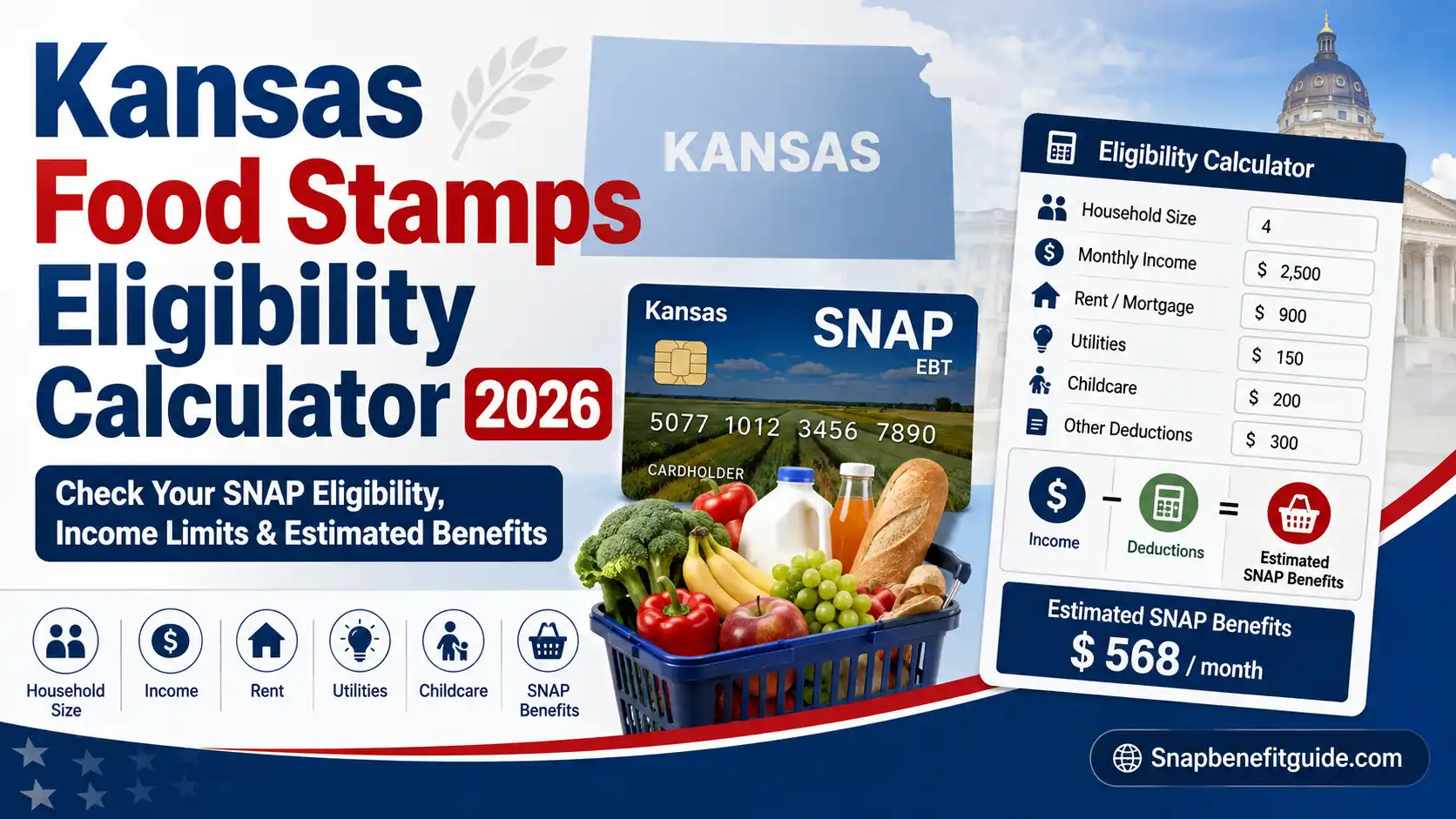
The Kansas food stamps eligibility calculator helps you find out whether your family could eligible for Food benefits — and roughly how much monthly SNAP amounts you might get. It factors in family size, monthly income, allowable deductions, household expenses, and a handful of special rules that apply to certain situations.
Quick answer: Start with your household size. Calculate gross income, subtract allowable deductions, land on a net income number, then stack that against current Kansas and federal SNAP requirements. That’s the core of it.
One thing to be clear about upfront: a calculator gives you an estimate. Only the Department for Children and Families (DCF) in Kansas can make an official eligibility confirmation after reviewing your actual application.
How the Kansas SNAP Calculator Works
The process follows the same logic DCF uses when assessing eligibility. Six steps, and each one matters.
Step 1: Enter your household size
This isn’t just counting heads at an address. SNAP household rules depend on who lives together and who buys and prepares food together. Some situations have exceptions. Get this number right — it affects everything downstream.
Step 2: Calculate monthly income
The calculator will typically ask about:
- Wages and salary
- Self-employment income
- Social Security, SSI, or SSDI
- Unemployment benefits
- Pensions and retirement income
- Child support
- Other countable income
Whether income is earned or unearned changes how it’s treated in the calculation. That distinction matters.
Step 3: Apply allowable deductions
SNAP doesn’t count every dollar of income against you. Depending on your situation, you may be able to deduct:
- Standard deduction
- Earned-income deduction
- Shelter and housing costs
- Utility expenses
- Dependent care costs
- Legally obligated child support payments
- Qualifying medical expenses for eligible household members
Step 4: Determine net income
What’s left after deductions is your net SNAP income. Gross and net are not the same number — and that gap can be the difference between qualifying and not.
Step 5: Review special eligibility rules
Some households need a closer look. If your household includes an older adult, someone with a disability, a college student, an eligible non-citizen, or someone subject to work requirements, additional rules come into play.
Step 6: Estimate your benefit
The simplified formula looks like this:
Maximum SNAP allotment − approximately 30% of net SNAP income = estimated benefit
Real-world calculations get more complicated. Minimum benefit rules, specific deductions, and household circumstances can all shift the final number.
Check SNAP Eligibility by State — Free Calculator Tool
Kansas Food Stamps Income Limits 2026
For FY2026 — October 1, 2025 through September 30, 2026 — the USDA Food and Nutrition Service sets the following monthly income numbers for the 48 contiguous states and D.C.:
| Household Size | Gross Monthly Limit | Net Monthly Limit |
|---|---|---|
| 1 | $1,696 | $1,305 |
| 2 | $2,292 | $1,763 |
| 3 | $2,888 | $2,221 |
| 4 | $3,483 | $2,680 |
| 5 | $4,079 | $3,138 |
| 6 | $4,675 | $3,596 |
| 7 | $5,271 | $4,055 |
| 8 | $5,867 | $4,513 |
| Each additional person | +$596 | +$459 |
These numbers are a useful starting screen — not a final answer. Deductions, household composition, resources, and other rules all feed into the result.
Gross income vs. net income
Here’s where a lot of people go wrong. They see the gross income limit, assume they’re over it, and stop there. Don’t do that. A family that looks ineligible based on gross income may still eligibel once allowable deductions are factored in. Always run the full calculation.
Also See Kansas Food Stamps Income Limits — Full 2026 Breakdown
How Much SNAP Could You Get in Kansas?
Qualifying is one question. How much you’d receive is a separate one entirely.
Two Kansas households with identical wages can land on completely different benefit amounts if one has shelter expenses, childcare costs, or qualifying medical bills that the other doesn’t. That’s why running actual numbers through a calculator beats guessing based on income alone.
Kansas SNAP Deductions
Deductions can shift your result significantly. These are the main ones worth knowing.
Earned-income deduction
A portion of earned income is excluded before net SNAP income is calculated. This directly reduces what counts against you.
Shelter expenses
Rent or mortgage costs, plus certain utility expenses, can factor into a shelter deduction. For households with high housing costs, this is often the biggest variable in the calculation.
Childcare expenses
If you’re paying for dependent care so you can work, look for work, or participate in qualifying activities, those costs may count as a deduction.
Child support
Legally obligated child support payments you make — not voluntary, legally obligated — can be deducted from income.
Medical expenses
Households with an elderly or disabled member may be able to deduct unreimbursed medical costs beyond a certain threshold.
Tip: Don’t guess at these numbers. Pull your actual monthly expenses before running any calculation — estimates introduce errors that can skew your result in either direction.
Kansas SNAP Asset and Resource Limits
The current Kansas DCF resource limits are $3,000 for most households and $4,500 when at least one household member is age 60 or older or has a qualifying disability.
One caution: Food Stamps resource policies have shifted over the years, and outdated calculators sometimes show different numbers. If you’ve got savings or other assets to consider, check current Kansas DCF guidance directly rather than trusting a stale source.
Who Can Get Food Stamps in Kansas?
Kansas Food Assistance is administered by DCF under the federal SNAP program run by USDA and the Food and Nutrition Service (FNS). Eligibility isn’t determined by any single factor — it’s a combination of:
- Household composition
- Income and allowable deductions
- Resources
- Kansas residency
- Citizenship or eligible immigration status
- Student status (specific rules apply)
- Work requirements
- Elderly or disability status
Can I get SNAP if I work?
Yes. Employment doesn’t disqualify you. What matters is how your countable income, after deductions, compares against current limits. Plenty of working households receive SNAP.
Can seniors get food stamps?
Yes, and older adult households often qualify under different rules — including modified income calculations, higher resource limits, and additional deduction options.
Can disabled people get SNAP?
A qualifying disability can affect how deductions and resource rules apply, often in ways that make it easier — not harder — to qualify.
Can college students get SNAP?
Students enrolled at least half-time in higher education face specific eligibility rules. Being a college student doesn’t automatically disqualify you, but there are conditions you’d need to meet.
Kansas SNAP Work Requirements and 2026 Changes
Work requirements apply to certain adults, particularly those subject to Able-Bodied Adults Without Dependents (ABAWD) policies. Federal legislation passed in 2025 changed some eligibility requirements, including work rules and eligibility for certain non-citizens.
Because exemptions depend on age, disability status, caregiving responsibilities, and household circumstances, a generic statement about work requirements won’t tell you what applies to your situation. Check current Kansas DCF and USDA guidance when you apply.
Can I Get SNAP If I Have Money in the Bank?
Possibly, yes. Having savings doesn’t automatically disqualify you. Resource rules vary by household type, and what counts as a resource — and how it’s treated — depends on your specific circumstances. Enter accurate information. Leaving assets out of an application creates problems later.
Can I Get SNAP If I Receive Social Security?
Receiving Social Security, SSI, or SSDI doesn’t make you ineligible. The dollar amount, your household situation, and applicable deductions all shape the final result. For elderly or disabled households, additional SNAP provisions may also apply — often in ways that improve the outcome.
Kansas SNAP Eligibility Examples
Example 1: Single worker
A single Kansas resident with monthly wages runs those through the calculator with applicable deductions. Gross income alone doesn’t answer the question.
Example 2: Family of four
A four-person household compares income against the FY2026 standards while accounting for childcare, shelter, and any other qualifying expenses. Each expense entered can change the benefit estimate.
Example 3: Senior receiving Social Security
A senior household factors in Social Security income, housing costs, and unreimbursed medical expenses. Special elderly-household rules shift how the math works.
Example 4: Unemployed household
A recent job loss changes everything. The household should update income figures immediately and check whether it qualifies for expedited assistance.
The point these examples make: “I make $2,000 a month” tells you almost nothing about whether you qualify.
How to Apply for Kansas Food Assistance
If your estimate looks promising, the next step is a real application through Kansas DCF. The process generally goes:
- Submit an application
- Provide household and financial information
- Complete an interview when required
- Submit requested verification documents
- Wait for the official eligibility determination
- If approved, receive benefits via the state’s EBT card system
Documents you’ll likely need:
- Identification
- Proof of income
- Rent or housing information
- Utility expenses
- Childcare costs
- Medical expenses (when applicable)
- Social Security or benefit documentation
- Immigration status documentation (when applicable)
Don’t hold your application because you’re missing one document. Contact Kansas DCF and ask what verification is required for your case specifically. Delays cost you time and potential benefits.
Kansas SNAP Help Near You
Kansas residents in Wichita, Topeka, Kansas City, Overland Park, Olathe, Lawrence, Manhattan, Salina, Hutchinson, Garden City, Dodge City, Emporia, Pittsburg, and Liberal can find local assistance through Kansas DCF resources.
Useful search terms:
- SNAP office near me
- Kansas food stamp office
- Wichita SNAP assistance
- Topeka DCF office
- Kansas City KS food assistance
- SNAP application assistance near me
For official help, go through Kansas DCF directly rather than relying on unofficial local listings.
See Your Kansas SNAP Payment Date — 2026 Schedule
2026–2027 Kansas SNAP Changes
Kansas has received federal approval for a SNAP waiver that restricts eligible food purchases — specifically candy and soft drinks. That restriction is scheduled to take effect February 15, 2027. It’s not in effect now, as of August 2026.
Worth keeping an eye on if you’re planning ahead.
Common Kansas SNAP Calculator Mistakes
A few errors come up constantly. Avoid these:
- Using 2025 figures instead of current FY2026 numbers
- Treating gross income and net income as interchangeable
- Skipping deductions — especially shelter and medical
- Entering annual income when the calculator asks for monthly
- Assuming savings automatically disqualify the household
- Treating a calculator result as official approval
- Using outdated work-requirement information
- Assuming every household is subject to the same rules
Kansas SNAP eligibility checklist
Before applying, have this information ready:
- Household size
- Monthly gross income (all sources)
- Unearned income amounts
- Rent or mortgage information
- Utility expenses
- Childcare costs
- Child support payment amounts
- Unreimbursed medical expenses
- Resource and savings information
- Student status, if applicable
- Elderly or disability status
- Immigration or citizenship documentation when applicable
Alternatives and Additional Food Assistance
Not qualifying for SNAP doesn’t mean you’re out of options.
Depending on your situation, these programs may be available:
- Local food banks and pantries
- School meal programs
- WIC — for eligible pregnant women, infants, and children
- Temporary Assistance for Needy Families (TANF)
- Community food assistance programs
- Senior nutrition programs
Eligibility varies by program. Being denied SNAP doesn’t close every door.
FAQs About Kansas SNAP benefits estimator
What is the Kansas food assistance calculator?
It’s an estimation tool. Enter your household size, income, deductions, and expenses, and it gives you a sense of whether you might qualify for Kansas SNAP — and what your benefit could look like. Not an official determination.
What is the Kansas SNAP income limit for one person in 2026?
For FY2026, the monthly gross income limit for a single-person household is $1,696, and the net income limit is $1,305. Other eligibility rules still apply.
How much can a family of four make and get food stamps in Kansas?
The FY2026 monthly gross income limit for four people is $3,483, with a net income limit of $2,680. Actual eligibility depends on deductions and household circumstances.
Does rent affect SNAP eligibility in Kansas?
Yes. Qualifying shelter expenses — rent, mortgage, and certain utility costs — can reduce your countable income through the shelter deduction, which directly affects your estimated benefit.
Can I get food stamps while working in Kansas?
Yes. Working doesn’t disqualify you. The question is whether your income, after applicable deductions, falls within the current limits.
Does Social Security count as income for Kansas SNAP?
Social Security is included in the income calculation, but the effect on eligibility depends on household type, total income, and applicable deductions. Receiving it doesn’t mean you won’t qualify.
Can I get Kansas SNAP if I have savings?
Possibly. The latest resource limits are $3,000 for most households and $4,500 when at least one member is 60 or older or has a disable person. Always confirm latest rules with Kansas DCF.
How do I apply for food stamps in Kansas?
Apply through Kansas DCF. You’ll provide household, income, and expense information, complete an interview if required, and submit verification documents. DCF makes the official determination.
Is an online Kansas SNAP calculator official?
No. Any third-party calculator — including this one — is an estimator only. Kansas DCF makes the official decision after reviewing your application.
Conclusion
Run the calculator with real numbers — your actual rent, your actual childcare costs, your actual income — and you’ll get a useful estimate. A rough guess at household expenses produces a rough guess at eligibility, and that’s not particularly helpful when you’re making a real decision.
The calculator is a starting point. Kansas DCF is where the official answer comes from. Don’t skip the application because a number looked borderline — circumstances that seem like disqualifiers often aren’t once deductions are properly accounted for.
Official Resources
- Apply for Kansas Food Assistance — Kansas DCF
- Check SNAP Eligibility Online — Kansas DCF Self-Service Portal
- Verify FY2026 SNAP Income Limits — USDA Food and Nutrition Administration
- See FY2026 SNAP Allotments & Deductions — USDA FNA
This information is for guidance purposes only and does not constitute an official eligibility determination. SNAP income standards, work requirements, and program rules can change. Verify your specific circumstances and current requirements directly with Kansas DCF before making any decisions based on an estimate.

Sohail Asghar is a U.S. benefits researcher with over 2 years of dedicated experience studying EBT, SNAP, and Medicaid programs. He has helped thousands of readers understand their eligibility, payment schedules, and benefit rights through in-depth research and analysis of official government sources. His work focuses on making complex government benefit information simple and accessible for everyday Americans.